
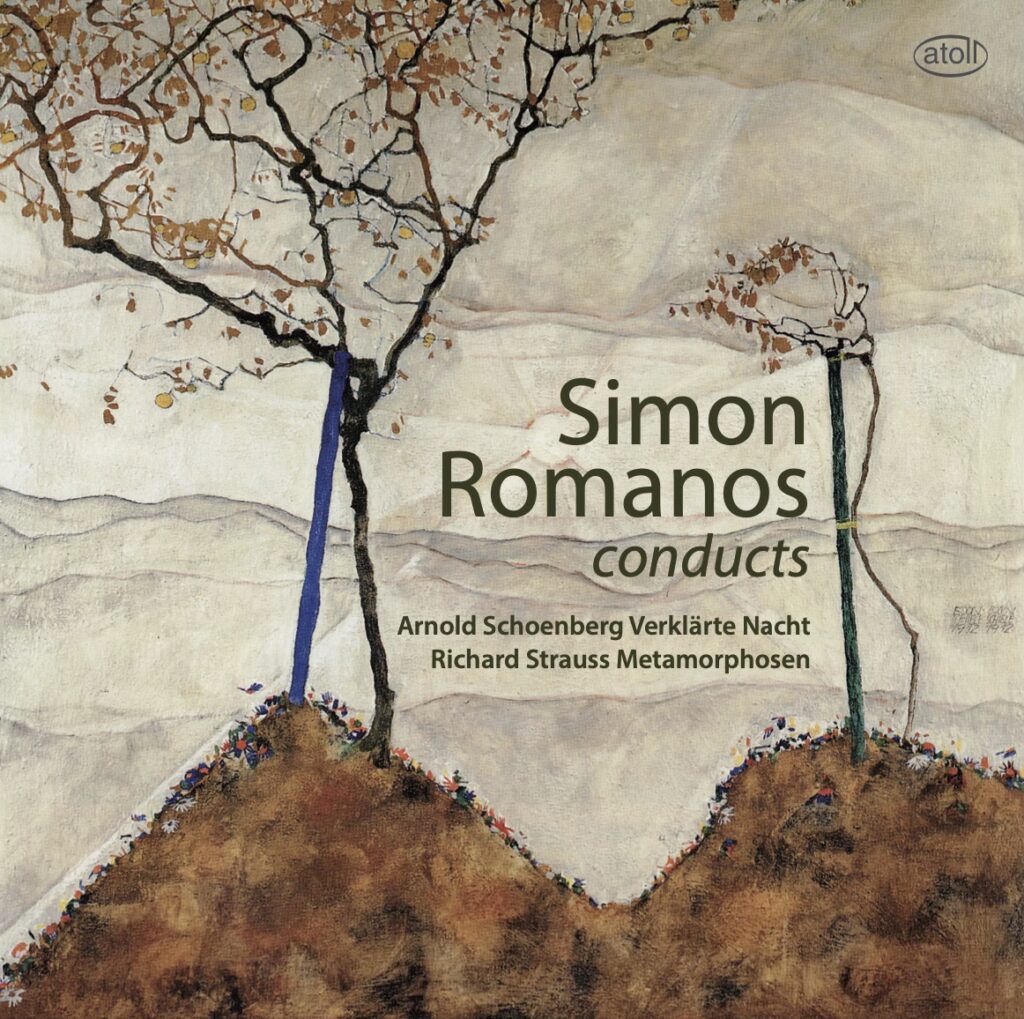
Playlist
- Schönberg: Verklärte Nacht Simon Romanos, London Mozart Players 29:24
- Strauss: Metamorphosen Simon Romanos, London Mozart Players 28:13
About Simon
Long established in Vienna and London, conductor Simon Romanos enchants audiences with his readings of the Austro-German repertoire. General Music Director of New Zealand’s Eternity Opera, his Mozart and Monteverdi have won accolades.
Directly upon graduating Romanos joined the Australian Ballet and Australian Opera and conducted recordings with the Sydney and Melbourne Symphony Orchestras for ABC Records.
He was one of the first Western conductors to work regularly with state and national companies behind the Iron Curtain — in Hungary, Yugoslavia, and the German Democratic Republic. Romanos continues to build ensembles of fine soloists and loves to combine the drive of chamber music with the sweep of a full orchestral sound.
Romanos appears with the Vienna Chamber Orchestra, English National Ballet, Scottish Opera, Stuttgart State Opera, and has curated two major London festivals, for the Queen Elizabeth Hall and the Royal Academy of Music. Romanos collaborates with famed artists including Joan Sutherland, Grace Hoffmann, Kelvin Coe, Marylin Rowe, Roger Woodward, and Charles Mackerras. He is committed to new music, giving premières of works by myriad leading composers including Anne Boyd, Franco Donatoni, John Rimmer, Iannis Xenakis, and Tomislav Zografski.
Simon Romanos carries a torch for opera in English, and believes in winning new audiences with his
vision.
Schoenberg: Verklärte Nacht
This piece is Schoenberg’s most loved work. He wrote it as an expression of adoration for Mathilde Zemlinsky, whom he was soon to marry.
It tells the story related by Richard Dehmel’s poem of the same name. Schoenberg uses its themes to re-address some of the topic matter of Wagner’s Tristan und Isolde: extramarital love, sex, betrayal, transcendent release — subjects taboo in society.
At a certain furious moment, he saturates the harmony with chromaticism. The key centres are still present, but are drowned in dissonance.
Schoenberg’s demands upon the musical language were constantly powered by his drive to understand the extremities of psychology and human experience.
In 1908 Mathilde’s infidelity with Richard Gerstl was to cause the young expressionist painter’s suicide. That infidelity also liberated Arnold, at last, completely and permanently from the tonal system, in his Buch der Hängenden Gärten.
Strauss: Metamorphosen
Strauss remained in Germany throughout WWII, although he became an increasing irritation to the authorities. He felt that as a leader and figurehead of modernism, he had a duty to protect German art and culture from the anti-intellectual regime.
By the late war years though, Strauss’s cultural credit was exhausted, and those authorities were losing their patience with him. They increasingly held his compositions back from performance. At the same time, he made it was clear he wanted nothing to do with the Reich Culture Ministry, having been appointed titular director without his agreement.
The final blow for Strauss was the bombing of Munich in October 1943. He saw in the wreckage of his beloved National Theatre the end of any chance to rescue German cultural life.
Music such as the final scene of die Meistersinger with its hymn to “Sacred German Art” carried an unbearable poignance for him, and he quotes obliquely from it, and from Tristan, along with the funeral march from the Eroica in his tragic yet exquisite study for 23 solo strings.